
FOR AUTHORS
News
SEMINAR ON UNIVERSITY AND HEALTH PEDAGOGY
Strengthening the pedagogical, clinical, digital, and ethical skills of teachers at the University Hospital “Le Bon Samaritain”
University Hospital Complex “Le Bon Samaritain”
Walia, N’Djamena, Chad
Hospital - Faculty of Medicine - School of Health - Health Center
Location: University Hospital “Le Bon Samaritain”, Walia, N’Djamena, Chad
Date: July 8-10, 2026
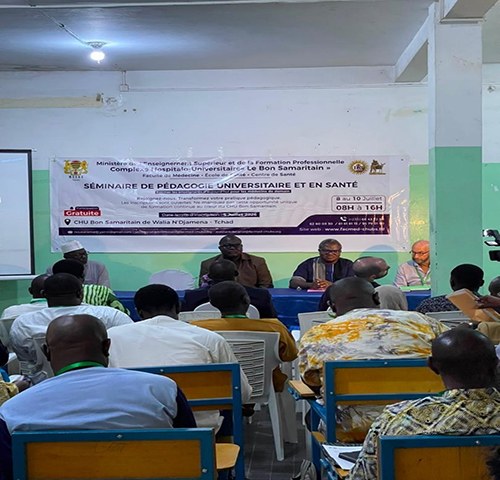
General view of the seminar room, with the attentive audience and the official banner specifying the theme and the organizers.
Executive summary
The Seminar on University Pedagogy and Health, held at the “Le Bon Samaritain” University Hospital Complex in Walia, N’Djamena, from July 8 to 10, 2026, aimed to strengthen the pedagogical capacities of teachers and supervisors in order to improve the design, implementation, evaluation, and modernization of teaching. It brought together physicians, teacher-researchers, clinical supervisors, students, doctoral candidates, educational leaders, and stakeholders from the education and health sectors around a common goal: to better train healthcare professionals through coherent, active, evaluable teaching practices adapted to the institutional realities of Chad.
The first day allowed for deeper exploration of instructional design, training needs analysis, pedagogical alignment, cognitive activation, active learning methods, public health as a pedagogical lever, and the quality requirements linked to the African and Malagasy Council for Higher Education (CAMES) system. Days 2 and 3 extended this dynamic through clinical pedagogy, supervision, skills assessment, the flipped classroom, blended learning, digital tools, AI, responsible research, ethics, and the science-community relationship.
The added value of the seminar lies in the articulation between three complementary dimensions: a pedagogical dimension, centered on the design and facilitation of learning; a clinical dimension, centered on the support of skills in real-life situations; and an institutional dimension, centered on quality, social responsibility, digital modernization, and the ethical grounding of medical training.
Introduction
Health education is not simply about transmitting a body of medical or scientific knowledge. It is about preparing professionals capable of understanding a situation, analyzing signs, making decisions in the face of uncertainty, communicating with patients, collaborating with other stakeholders, acting ethically, and responding to the real needs of communities. In the Chadian context, this requirement takes on particular significance, as health training institutions are called upon to contribute directly to improving the quality of care, prevention, health promotion, and strengthening the health system.
Being a health teacher therefore means embracing intellectual, pedagogical, clinical, and social responsibility. The quality of teaching certainly depends on the teacher’s disciplinary expertise, but it also depends on their ability to organize learning situations, support learners, assess skills, and effectively use digital tools. The report from the first day rightly reminds us that the transmission of knowledge requires mastery of teaching methods capable of improving the teacher-student relationship in an environment characterized by rapid digital evolution.
It was with this in mind that the University Hospital “Le Bon Samaritain” (CHU-BS), in partnership with other institutions, organized this 3-day seminar. The seminar provided a framework for reflection, training, and exchange on university and healthcare pedagogy. It also served as a space for institutional knowledge sharing: participants were able to compare their practices, clarify concepts, identify pedagogical tools, and consider the conditions for a gradual transformation of teaching towards a competency-based approach.
This narrative report aims to document the seminar’s proceedings, summarize the main learning outcomes, and incorporate the elements from days 1, 2, and 3, following the detailed program. It may be shared with the management of the CHU-BS, the Faculty of Medicine, academic partners, supervisory authorities, and quality assurance bodies.
Context and justification
The continuous improvement of the quality of higher education in health requires universities to rethink their teaching practices. Medical schools and health professions schools can no longer simply focus on accumulating content. They must ensure that learners develop effective, observable, transferable skills that are useful in real-world professional situations.
The seminar’s terms of reference (ToR) clearly outline this ambition. They mention the need to harmonize teaching practices, strengthen instructional design, and promote the adoption of active, learner-centered methods. They also emphasize the importance of clinical supervision, competency assessment, digital pedagogy, and AI-driven innovation in modern university education.
The institutional context of the CHU-BS reinforces the relevance of this approach. As a university hospital complex, it simultaneously fulfills a mission of care, training, research, and community service. This position demands a pedagogy connected to clinical reality, public health needs, academic standards, and ethical requirements. Such a pedagogy must enable teachers to move from the role of mere transmitters of content to that of designers, facilitators, supervisors, evaluators, and guides of learning pathways.
The seminar also addressed practical challenges, namely:
- the need for better logistical planning,
- the need for reliable technical support for module projection,
- the request for concrete examples, practical exercises, local case studies,and more in-depth exchange sessions.
These difficulties do not diminish the value of the seminar; on the contrary, they constitute useful benchmarks for improving future editions and building a sustainable system for educational development.
Seminar objectives
General objective
Strengthening the pedagogical capacities of teachers and supervisors in order to improve the design, implementation, evaluation, and modernization of teaching.
Specific objectives
- Clarify the principles of instructional design applied at the faculty level.
- Deploy active teaching methods adapted to medical disciplines.
- Strengthen clinical teaching and supervision practices.
- Improve the assessment of learning and skills.
- Integrate digital university teaching tools.
- Explore relevant uses of AI in educational innovation.
- Reflecton the issues of ethics, research, and educational responsibility.
General methodology
The seminar methodology was based on thematic presentations followed by discussions with participants. The report for day 1 indicates that the sessions were organized into sequences, with presentations, discussions, and breaks. The ToR called for a participatory and practice-oriented approach: interactive presentations, group work, sharing of experiences, mini-workshops, case studies, and plenary debriefings.
This methodology reflects the spirit of the seminar: participants were not merely recipients of information, but active participants in a collective reflection on improving healthcare training. The materials used demonstrate a commitment to linking theoretical input to teaching practices, clinical realities, and institutional challenges.
Narrative outline of the seminar
Day 1 - University educational engineering and active methods in health
The first day laid the conceptual foundation for the seminar. According to the day’s report, it began with an opening ceremony featuring speeches by the Director General of the CHU-BS and the Director of General Education, Dr. Famargué Kaitamba, and the Director of Higher Education. This opening served to reiterate the institutional purpose of the activity: to strengthen the capacities of teachers and supervisors in order to improve the quality of university and health education.
The morning session focused on university instructional design. Professor Kimassoum Rimtebaye introduced the analysis of training needs and medical pedagogical alignment. The topics covered included training needs, learning objectives, pedagogical alignment, and course structure. The central idea was that all training must begin with a clearly identified need and lead to explicit competencies.
Professor Sefirin Djiogue then elaborated on the pedagogy of alignment, emphasizing the convergence between skills, content, methods, and assessments. The discussions highlighted that pedagogical alignment helps prevent confusion among learners, inappropriate activities, and unfair assessment practices. It constitutes a principle of quality for all university programs.
Njoya’s presentation on cognitive activation and skills development in medical training enriched this discussion. He demonstrated that skills are not developed simply through the reception of content, but rather through the execution of complex tasks that require learners to analyze, compare, interpret, argue, decide, and reflect on their actions. Active learning thus becomes a lever for aligning education more closely with the real demands of professional practice.
The afternoon session focused on active learning methods in healthcare. Professor Ali Mahamat Moussa presented public health as a pedagogical tool in medical training. His presentation emphasized that public health allows students to better understand the determinants of health, the challenges of prevention, health promotion, and the health realities of communities. It helps train professionals capable of moving beyond a purely curative approach to adopt a comprehensive, community-based perspective.
Professor Choua Ochemi addressed university pedagogy and the CAMES evaluation system. The discussions underscored the importance of teaching quality, course structure, learning assessment, and the continuous improvement of teaching practices. Quality assurance thus emerged as a prerequisite for institutional performance and academic credibility.
Professor Sefirin Djiogue’s presentation on alignment-based pedagogy – or constructive alignment – deepened this framework with rigorous precision. Constructive alignment is based on the principle that the three components of teaching – learning objectives, proposed activities, and assessment methods – must be formulated according to the same cognitive logic. If the objective is to analyze, then analytical activities and an analytical assessment are necessary. To learn to argue, one must argue; to learn to solve, one must solve. This coherence protects students from common pedagogical contradictions: announcing complex skills but offering only didactic lectures, planning group activities but assessing solely through memorized exams, formulating overly vague objectives, or neglecting the transparency of assessment criteria. A well-formulated skill specifies a level of expectation and a context of application, and alignment always begins with a rigorous definition of what is truly expected of students.
Key takeaways from day 1
The major takeaways from this first day relate to the need to design training programs based on a precise analysis of needs, the importance of constructive alignment between skills, content, methods and assessment, the relevance of active methods, the central role of the teacher as a facilitator, and the importance of assessment in higher education.
Difficulties and suggestions arising from day 1
Day 1 revealed several challenges: insufficient technical preparation for module presentations, room for improvement in logistical planning, sometimes insufficient time allotted for in-depth exploration of concepts, a need for more practical exercises and role-playing scenarios, a high thematic density, and limited discussion time. These observations provide important lessons for improving future editions.
The suggestions made call for planning technical backup solutions, improving logistical planning, allocating more time to practical workshops, increasing case studies from the local academic context, organizing exchange sessions between participants, making materials available after the seminar, and creating a network or follow-up framework between participants and trainers.
Day 2 - Clinical pedagogy, supervision, and skills assessment
The second day can be seen as a clinical extension of the first. After laying the groundwork for pedagogical design and active learning methods, the seminar shifted its focus to real-world learning, in direct contact with patients, and to skills assessment. The day’s themes were presented successively by Dr. Mahamat Ibni Bichara, Dr. Claude Ernest Njoya, and Prof. Kimasoum Rimtebaye, who explored the links between clinical supervision, the flipped classroom approach, cooperative learning, formative and summative assessment tools, objective structured clinical examinations (OSCEs), and competency-based education.
The session on clinical pedagogy served as a reminder that medicine is not learned solely from books. Clinical learning relies on direct observation, demonstration, guided questioning, contextualized reasoning, constructive feedback, and progressive support for the learner. The clinical instructor emerges as a professional role model, facilitator, supportive evaluator, and guide to reasoning.
Methods such as the bedside, the SNAPPS model, and the One-Minute Preceptor offer practical frameworks for structuring interactions at the patient’s bedside or in the wards. They allow learners to articulate their reasoning, identify their difficulties, reinforce what is done well, and correct errors without humiliation. They thus address a major need: transforming everyday clinical situations into learning opportunities.
Professor Sefirin Djiogue’s contribution on the synergy between the flipped classroom and collaborative work provided a rigorous demonstration of this paradigm shift. The flipped classroom is based on a reversal of learning time: core content is reviewed before the session in the form of video clips, guided texts, quizzes, or interactive materials, while in-person time is freed up for explanations, exercises, discussions, case studies, and reviewing errors. Students can revisit the resources at their own pace, which promotes appropriation and accessibility. The teacher thus has more time to observe difficulties, manage groups, and provide personalized support.
The addition of collaborative work transforms this approach into a comprehensive system. A student who has prepared content alone may still only partially understand it; the group allows for the exchange of viewpoints and clarification. Collaborative work develops argumentation, scientific communication, listening skills, and a sense of responsibility. Peer interaction often fosters a more robust understanding than passively listening to a presentation. The synergy between the two approaches corresponds to a logic of preparation, interaction, consolidation, and transfer. The cooperative methods that can be used include case studies, peer instruction, jigsaw puzzles, problem-solving, and mini-projects, which transform the group into a space for collective production rather than simple discussion.
The session on clinical assessment emphasized a crucial distinction: we are not only evaluating what the student knows, but also what they do in real or simulated situations. Tools such as direct observation, OSCE, mini-clinical evaluation exercise (CEX), direct observation of procedural skills (DOPS), and portfolios allow for a better assessment of clinical reasoning, communication, professionalism, and technical skills. A good assessment must be valid, reliable, objective, feasible, and educational.
What was learned on day 2
The outcomes of day 2 can be formulated as follows: better understanding of clinical supervision, appropriation of feedback as a learning tool, identification of concrete tools for assessing skills, awareness of the limits of purely theoretical assessment and recognition of the need to train assessors.
The difficulties
The difficulties that may have been encountered during this type of training day stemmed from the density of the tools presented, the need for practical demonstrations, the lack of time to simulate assessment situations, and the usual constraints of the clinical setting: workload, learner stress, potential subjectivity of evaluators, and variability in care situations. The corresponding suggestions include planning simulation workshops, exercises in constructing assessment grids, feedback simulations, and support for instructors in the progressive use of the Mini-CEX, DOPS, OSCE, and portfolio tools.
Day 3 - Digital pedagogy, AI, ethics, research, and educational responsibility
The third day broadened the seminar to include digital modernization, innovation, ethics, and the social responsibility of teaching and research. It allowed participants to situate university pedagogy within an environment characterized by digital tools, AI, collaborative platforms, responsible research, and the dialogue between science and society.
The digital pedagogy of higher education was introduced by a contribution from Karagoun Mahamoud Kouno, Coordinator of the University Pedagogy Center at the École Normale Supérieure in N’Djamena. His presentation emphasized that the global era is one of quality and that good pedagogical practices are now a guiding principle for teacher trainers seeking to improve the quality of teaching and learning and student success. He demonstrated that teacher-researchers who are also trainers must develop theoretical, practical, pedagogical, scientific, digital, and interpersonal skills adapted to current demands. To teach in health sciences, it is not enough to hold a doctorate in a specific field; one must understand the learner to be trained on scientific, pedagogical, and human levels. He grounded this reflection in learning theories, from behaviorism to connectivism, including cognitivism, constructivism, and socio-constructivism. Connectivism, in particular, is one of the most suitable theories for implementing digital pedagogy, as it asserts that learning occurs in the creation and sharing of connections in networks of information, people, and resources.
Professor Sefirin Djiogue extended this discussion with a presentation on the design of hybrid, interactive, and supported courses. Hybrid teaching combines face-to-face and distance learning activities within a single framework. Hybridization is not simply adding digital elements to an already comprehensive course, but rather rethinking the learning scenario: online and in-person sessions must be complementary and structured around shared objectives. The components of an effective hybrid course include digital learning environments, targeted online resources, interactive activities, learning monitoring, and in-person sessions reserved for clarification, practice, supervision, and application. Resources should be concise, targeted, and adapted to the students’ level; information overload, which discourages consultation, must be avoided. Interactivity is essential to prevent passive use of digital tools: students must be active – responding, comparing, producing, arguing, and commenting. A good hybrid course is not a fragmented course, but an intelligently orchestrated one.
The Leco - Learning Connections presentation, dedicated to a collaborative academic platform, enriched the discussion on how to transform students’ scattered exchanges into structured, reusable, and valuable knowledge. It stemmed from the observation that questions, files, and updates often disappear in overcrowded discussion groups, that useful resources remain fragmented, and that collaborations are limited to a single class or cohort. Leco proposes centralizing academic questions, resource sharing, structured answers, and collaborative projects to make student contributions more visible.
From an institutional perspective, Leco’s value to the CHU-BS lies in its potential to support active learning. The platform can help students ask better questions, receive structured answers, share useful documents, identify recurring difficulties, and participate in academic projects. The support team recommends a cautious and gradual approach: start with a class or cohort, observe actual usage, gather feedback from teachers and students, and then refine the system before any wider implementation. This pilot project approach aligns well with local constraints and the need to verify pedagogical effectiveness before broader deployment.
The presentation on responsible research and the science-community relationship brought an ethical, social, and strategic dimension to the third day. It served as a reminder that contemporary science is subject to increasing pressure for social relevance, transparency, and accountability. In the fields of biosciences and health, the challenge is no longer simply to produce knowledge, but to move from science for society to science with and for society by involving communities in the priorities, methods, and outcomes of research.
The presentation outlined responsible research and innovation around five fundamental principles: public engagement, gender equality, open access, ethics, and science education, supported by institutional governance capable of operationalizing them. It also emphasized strategic dimensions relevant to the Sahelian context: stakeholder inclusion, responsiveness to social feedback, anticipation of future impacts, and reflection by researchers and teachers on their own practices. For the University Hospital of Sahel-Saharan Africa (CHU-BS), these principles encourage the conception of research, teaching, and healthcare innovations as collaborative processes involving patients, communities, and local stakeholders.
The same presentation linked scientific responsibility to African and Sahelian realities. It highlighted the importance of responsible technology transfer, cultural acceptability, consideration of the Sahelian exposome, traditional and complementary medicine, and the One Health approach. The example of a fever outbreak in a pastoral community demonstrates that medical analysis must be integrated with veterinary, sociological, and environmental dimensions. This interdisciplinary approach gives 21st-century physicians and educators in the Sahel a broader role: competent clinician, cultural mediator, responsible researcher, and facilitator of dialogue with communities.
The third day concluded with a presentation by Father Carlos Gomez-Virseda, SJ, a physician, Jesuit priest, and bioethics researcher at KU Leuven, entitled “500 Years of Jesuit Pedagogy in Service of the Integral Development of the Human Person”. His presentation offered a historical, spiritual, and practical perspective on the purpose of medical training. He reminded the audience that we are living through an educational revolution marked by artificial intelligence, clinical simulation, digital learning, and new forms of assessment, but that the more our technology advances, the stronger our foundations must be.
Jesuit pedagogy, rooted in the Ratio Studiorum of 1599, the first major universal pedagogical model, is based on the Ignatian Pedagogical Paradigm, whose five stages are: context, experience, reflection, action, and evaluation. This framework encourages an understanding of the healthcare system within its social and cultural realities, training through direct contact with patients, giving meaning to lived experiences, entrusting progressive responsibilities, and integrating skills and professional growth. The ultimate goal is the holistic formation of the individual, structured around four dimensions: Utilitas – competence and social utility; Iustitia – social responsibility and attention to vulnerable individuals; Humanitas – relationship, listening, and the humanization of care; and Fides – integrity, meaning, and discernment.
Applied to the context of the CHU-BS, this approach highlights that training a doctor in Chad means preparing someone to practice in a context marked by limited resources, intense social pressure, daily ethical dilemmas, and a real risk of burnout. The transferable Ignatian tools – Cura Personalis (care of the whole person), Magis (the pursuit of continuous excellence), and Discernment (prudent judgment) – offer concrete guidelines for transforming the teacher into a guide for the individual, not just a transmitter of knowledge. The central message can be summarized as: competence, compassion, coherence, and collaboration.
Achievements from day 3
The achievements of day 3 can be formulated as follows: increased understanding of the possibilities of digital technology and AI, mastery of the principles of designing hybrid courses, appropriation of good digital teaching practices, openness to digital academic collaboration via Leco, appropriation of the principles of responsible research adapted to the Sahelian context, and anchoring of medical training in a humanistic and integral vision of the person inspired by Jesuit pedagogy.
The difficulties
Potential challenges include unequal access to digital infrastructure, the need for teacher training on tools, the necessity of data protection, caution in the use of AI, the ability to run a pilot project without overburdening teachers, and the difficulty of translating general ethical concepts into operational institutional procedures. The corresponding suggestions include launching digital pilot projects, creating AI usage charters, providing progressive teacher training, experimenting with collaborative platforms, developing evaluation frameworks for actual use, and establishing an institutional framework for responsible research.
Cross-cutting summary of the 3 days
Axis |
Day 1 |
Day 2 |
Day 3 |
Institutional summary |
|
Instructional design |
Needs analysis, objectives, alignment |
Application in clinical pedagogy |
Hybrid and digital screenwriting |
To build coherent, contextualized, and skills-oriented systems |
|
Active methods |
Cognitive activation, complex tasks, APP/PBL |
Flipped classroom, feedback, active supervision |
Digital collaboration, platforms, AI |
Engage the learner and support in-depth learning |
|
Assessment |
CAMES alignment and quality assurance |
ECOS/OSCE, Mini-CEX, DOPS, portfolio |
Digital monitoring and support for evaluation |
Moving from knowledge assessment to skills assessment |
|
Responsibility |
Public health and population needs |
Safety of care and professionalism |
Ethics, RRI, One Health, science-community |
Linking medical training, quality of care, and social responsibility |
Main consolidated acquisitions
- A strengthened understanding of instructional design and the alignment between needs, skills, content, methods, and assessments.
- An appropriation of active methods as levers for cognitive activation and skills development.
- Recognition of the role of public health as an educational framework for training doctors who are attentive to social determinants, prevention, and community needs.
- A better understanding of clinical pedagogy as real-world learning, supported by supervision, feedback, and role modeling.
- A clarification of clinical assessment tools and their conditions of validity, reliability, objectivity, feasibility, and educational usefulness.
- An opening towards digital pedagogy, hybrid courses, collaborative platforms, and supervised uses of AI.
- An integration of responsible research, ethics, the One Health approach, and science-community dialogue into the institutional vision of health education.
Cross-cutting difficulties and areas for improvement
- Strengthen logistical and technical preparation, particularly for the projection of materials and the management of equipment.
- Allocate more time for practical workshops, case studies, tool-building exercises, and role-playing scenarios.
- To lighten certain thematic sequences or to plan follow-up sessions in order to promote the gradual appropriation of concepts.
- Develop examples from the local university, hospital, and healthcare context.
- Improve post-seminar documentation: materials, guides, templates, references, digital tools, and evaluation grids.
- Establish a monitoring framework to measure the application of acquired knowledge in courses, internships, and clinical services.
Operational recommendations
To the management of the CHU-BS
- Establish a university teaching unit or committee responsible for monitoring the recommendations.
- Institutionalize regular training in medical pedagogy, clinical supervision, assessment, and digital education.
- Plan for a reliable technical setup for future training sessions and a contingency plan in case of failure.
To the Faculty of Medicine
- Develop harmonized frameworks for course plans, learning objectives, teaching methods and assessment procedures.
- Implement pilot modules using flipped classroom methods, complex tasks, case studies, and problem-based learning.
- Organize follow-up on pedagogical alignment in teaching units and internships.
To teacher-researchers and clinical supervisors
- Design courses based on the expected skills and not solely on the content to be transmitted.
- Gradually use active methods and structured feedback.
- Experiment with clinical assessment tools: Mini-CEX, DOPS, portfolios, observation grids, and OSCE.
- Transform everyday clinical situations into learning opportunities, while respecting the patient and the safety of care.
To academic and technical partners
- Support the development of a continuing education program in university pedagogy and health.
- Support digital pilot projects and collaborative tools adapted to the local context.
- Encourage responsible research partnerships based on ethics, open access, community inclusion, and the One Health approach.
Proposed monitoring plan
Priority action |
Proposed manager |
Indicative deadline |
Expected product |
|
Create a university teaching committee |
CHU-BS/Faculty |
Short-term |
Creation notes and roadmap |
|
Harmonize course and assessment templates |
Educational coordination |
Short-term |
Approved templates |
|
Train supervisors on Mini-CEX, DOPS, and feedback tools |
Faculty/clinical services |
Medium-term |
Practical workshops and tested grids |
|
Launch a pilot module in a flipped or hybrid classroom |
Volunteer teachers |
Medium-term |
Experimentation report |
|
Create a framework for sharing educational resources |
Educational/digital unit |
Medium-term |
Resource directory or platform |
|
Documenting the effects of educational innovations |
Pedagogical Committee |
Continuous |
Follow-up reports and recommendations |
General conclusions
The seminar on university and healthcare pedagogy was an important moment for reflection and capacity building within the CHU-BS. It served as a reminder that the quality of medical training relies on rigorous pedagogical design, active facilitation of learning, structured clinical supervision, competency-based assessment, and a responsible openness to digital technology, AI, ethics, and research.
The inclusion of the report from day 1 enhances our understanding of the actual progress of the work, the achievements, the difficulties encountered, and the suggestions. The approach moves from instructional design, through clinical practice and evaluation, to digital technology, ethics, and social responsibility.
The logical next step following this seminar should be the implementation of a sustainable educational development framework. This involves transforming the lessons learned into institutional practices, shared tools, internal standards, and innovations adapted to the realities of the CHU-BS and Chad, in order to contribute to more effective, humane, responsible, and learner-centered medical training.
Acknowledgments
The Faculty of Medicine of the Le Bon Samaritain University Hospital Complex expresses its sincere gratitude to the Ministry of Higher Education and Vocational Training, as well as to the facilitators, keynote speakers, faculty members, clinical supervisors, and researchers from various national, regional, and international academic institutions; to the students, doctoral candidates, and stakeholders in the education and health sectors who contributed to the successful organization of this seminar.
The Faculty also extends its appreciation to its partner institutions and resource persons whose presentations helped position university and health professions education within a comprehensive academic, clinical, digital, ethical, and institutional framework.